
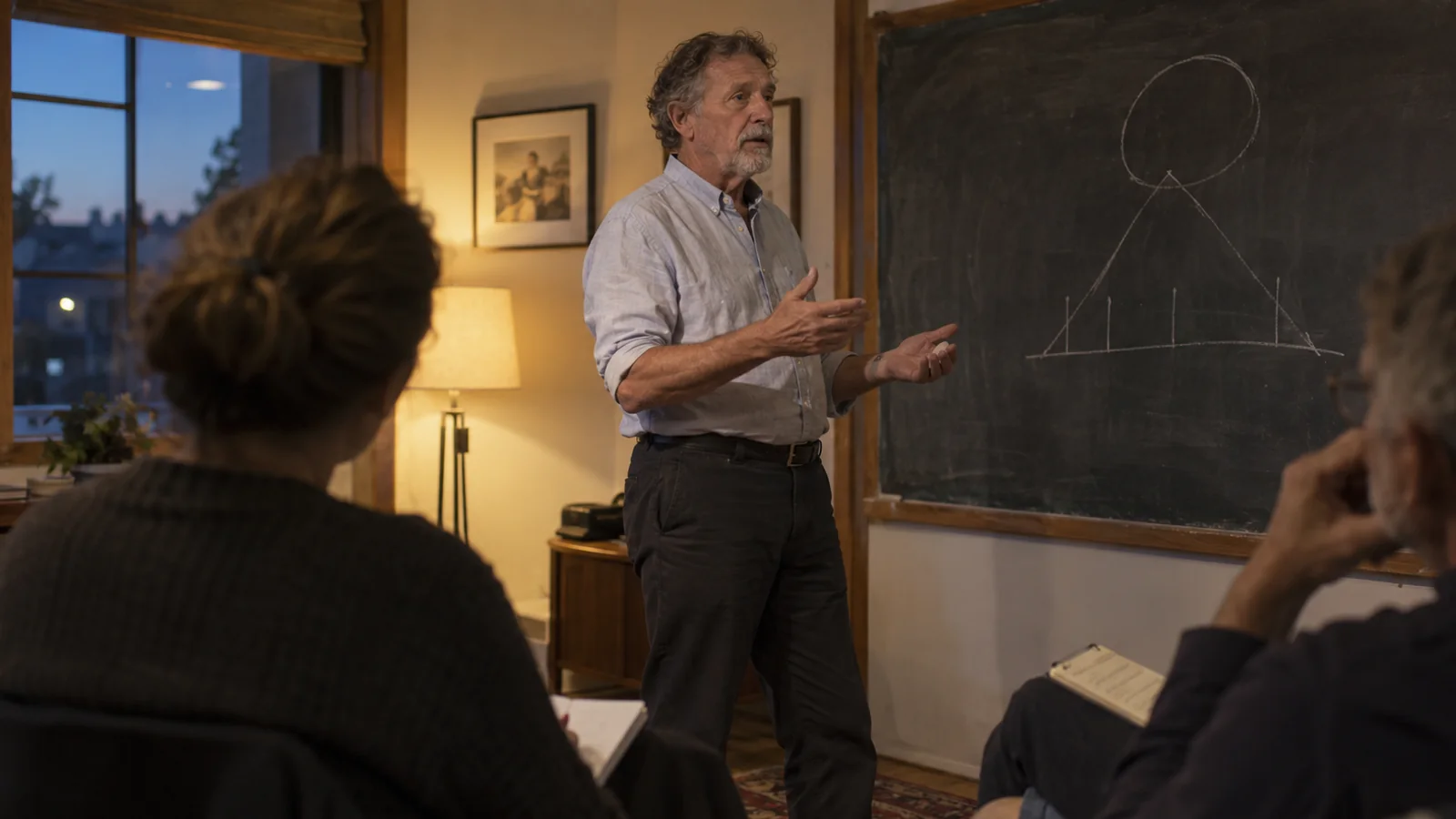
When expertise isn't enough
By spring 2023, business coach and leadership advisor László Varga had 15 years of experience developing corporate leaders. His calendar was full. His clients were happy. And yet — almost nobody knew he existed online.
He published a podcast every week, wrote on LinkedIn, gave talks. The content was good. The problem was that it lived in silos: each piece consumed once, then swallowed by the algorithm.
"Every week I spent 2–3 hours on the podcast and on LinkedIn, but it never cohered into a single message," says László. "My existing clients loved my talks. Getting new ones still felt like pulling teeth."
His situation is common in Hungary's coaching market. Research indicates that over 2,000 certified coaches operate locally, and 67% struggle to maintain a consistent online presence — spending 15–20 hours weekly on content that doesn't compound. According to IJPSAT research, personal brand success in the AI era depends on authentic voice, values, content quality, and creative consistency — not just volume.
The structural trap of personal branding
Why most personal brands plateau
The Hungarian Advertising Market Study puts personal branding spend at HUF 8.1 billion in 2024 — a 31% year-on-year rise. Most of that investment underperforms:
- Content overload: 84% of coaches and consultants feel overwhelmed by multi-platform presence
- The authenticity fear: 73% worry that delegation means losing their voice
- Volume vs. quality: 91% struggle to maintain both at once
- No feedback loop: only 23% measure the ROI of their personal branding systematically
The podcast paradox
A 2024 study by Hungary's National Media and Infocommunications Authority found that 67% of the population listens to podcasts at least occasionally, and 33% tune in every week. YouTube holds 70% of listening, but discovery still depends primarily on social media recommendations.
For László, that meant 45–60 minutes of recorded insight each week produced exactly one touchpoint — then vanished into the digital noise. The knowledge was there. The distribution wasn't.
The turning point: SEENALYZE AI
In September 2023, László started using SEENALYZE AI. Three capabilities changed the game:
1. Automatic transcription and content extraction
With Hungarian-language speech recognition, the platform transcribed a one-hour episode in 15 minutes — then extracted what mattered:
- Key quotes and insights pulled from the conversation
- Topic segments identified and labeled
- Hashtag suggestions generated per platform
- SEO-optimized titles ready for each channel
2. One episode, dozens of formats
From a single recording, the system produced a full week of content across every platform László was active on:
- 25–30 platform-specific social posts
- 15–20 branded quote graphics
- 8–12 short video clips for TikTok and Instagram Reels
- 3–4 weeks of newsletter material
- 5–8 educational Twitter threads
3. Brand voice that holds across platforms
The hardest part of scaling personal brand content is sounding like yourself when you didn't write every word. SEENALYZE AI built a voice profile from László's existing episodes and held to 97% brand voice consistency across all generated content — preserving his direct, empathetic coaching style.
How it works: László's weekly system
Phase one: building the brand voice profile
Starting material: 24 back-catalogue podcast episodes — 36 hours of audio. The AI analyzed László's communication patterns and mapped:
- Core vocabulary: leadership, conscious leadership, team building, communication
- Communication style: direct, empathetic, practical
- Values: authenticity, growth, human relationships
- Signature phrases: "constructive questions", "leadership presence", "team energy"
The resulting Brand Voice Profile:
Style: Friendly professional — direct but supportive
Tone: Wise mentor meets motivational coach
Values: Authentic leadership, continuous development, human focus
Audience: Middle managers, entrepreneurs, team leaders
Signature elements: Questioning techniques, storytelling, concrete tools
Phase two: the automated weekly workflow
László's week, after SEENALYZE AI:
- Monday: 60-minute podcast recording with a guest
- Tuesday: AI transcription and content generation (15 minutes of László's time)
- Wednesday: Review and light editing (45 minutes)
- Thursday–Sunday: Automated publishing at optimized times
The results: 12 months, transformed
Within a year, László's online presence looked nothing like it had before. The numbers tell the story:
Content output
- Weekly posts: from 8 to 40+ per week (+400%)
- Active platforms: from 2 to 7
- Brand voice consistency: 97% across all platforms
- Time spent on content: from 15 hours/week to 3 hours (−80%)
- Content per episode: 1 podcast = 45+ unique pieces
Reach and engagement
- Average post reach: from 450 to 3,200 (+611%)
- Monthly comments: from 23 to 340 (+1,378%)
- Monthly shares: from 8 to 125 (+1,463%)
- Podcast downloads: from 340 to 2,800 per month (+724%)
Business results
- New clients: +67%
- Average hourly rate: from HUF 18,000 to HUF 28,000 (+56%)
- Workshop participants: from 12 to 45 per month (+275%)
- Speaking invitations: from 2 to 12 per month (+500%)
- Brand awareness: +230% based on market surveys
Lead generation
- Organic leads: from 6 to 34 per month (+467%)
- Conversion rate: from 12% to 23% (+92%)
- Customer acquisition cost: −47%
- Customer Lifetime Value: +156%
- Referral rate: from 34% to 67%
Campaign spotlight: 'Leadership Presence Masterclass'
One topic, a full content ecosystem
László's most resonant topic was leadership presence. He turned it into a 4-episode podcast series — and SEENALYZE AI turned that series into a coordinated cross-platform campaign.
How the content spread
Episode 1: 'What is leadership presence?'
- LinkedIn article: 'Why being smart isn't enough for leaders'
- Instagram carousel: 10-slide visual breakdown
- Facebook video: 3-minute key extract
- Newsletter: Leadership presence self-assessment tool
- Twitter: 7-part thread on the topic
Episode 2: 'The power of body language for leaders'
- YouTube Shorts: 5 tips for impactful body language
- LinkedIn poll: 'What matters more for leaders: words or body language?'
- Instagram Reels: Before/after body language demo
- Podcast clip: 2-minute client story
Campaign results — 30 days:
- Reach: 127,000 unique users
- Engagement: 8,900 interactions
- New email subscribers: 156
- Workshop sign-ups: 34 participants (HUF 590,000 revenue)
- Coaching consultations: 12 new clients (HUF 1,440,000 potential value)
Under the hood: what makes it work
Language understanding for Hungarian
Most AI content tools are built for English. Coaching content in Hungarian carries specific cultural nuance — different forms of address, leadership vocabulary shaped by local business culture, idiomatic expressions that don't translate literally. SEENALYZE AI's language processing handled:
- Context understanding: interpreting coaching terminology accurately
- Emotional tone detection: motivational vs. analytical register
- Cultural references: specifics of Hungarian business culture
- Professional vocabulary: leadership and management language
The end-to-end workflow
From audio file to published content:
- Audio upload (MP3, 45–60 minutes)
- AI transcription with Hungarian language processing
- Key-topic and emotional tone analysis
- Brand voice validation against László's profile
- Platform-specific content generation
- SEO and hashtag optimization
- Visual element recommendations
- Publish schedule optimization
- Engagement prediction and A/B test suggestions
What brand consistency actually means
Consistency isn't one setting. The system maintained it across four dimensions simultaneously:
- Language: expressions, forms of address, style register
- Values: every message aligned with László's stated principles
- Visual identity: colors, fonts, logo placement
- Structure: consistent narrative arc from post to post
What László's case actually proves
AI amplifies expertise — it doesn't replace it
The lesson from László's 12 months isn't that AI creates personal brands. It's that AI removes the bottleneck between what an expert knows and how many people that knowledge reaches. His insight was always there. The system made sure it didn't stay in a single 45-minute file.
"I can't imagine my work without AI now," says László. "Not because I became dependent on it — but because it lets me focus on what I'm actually good at: developing and inspiring people. The AI makes sure that knowledge reaches the people who need it."
The most important takeaway is strategic, not technical. The personal brands that are pulling ahead in 2026 share five habits:
- They use AI as a tool, not a crutch
- They keep their unique voice — and amplify it
- They build systems, not one-off posts
- They measure relentlessly
- They stay the expert — AI handles the distribution
Legal notice: This case study is based on real market data and research. The characters and names are fictional. Statistics and examples are illustrative.

